Sunday, March 22, 2015

Homeward Bound

Breakfast in cemetery
Boy tastin’ wild berry
Touch girl, apple blossom
Just a boy playin’ possum

We'll come back for Indian Summer
And go our separate ways

What is that cheerful sound?
Rain fallin’ on the ground
We'll wear a jolly crown
Buckle up, we're homeward bound


It’s been almost two weeks since the last Ebola patient was discharged in Liberia. It’s been over a month since my mom left us. It’s been more than three months since I saw Jess and the girls. The rainy season is almost here. Time to go home.

Those of you who know me well know I’ve been a fan of REM since the first four drum notes that start Radio Free Europe came over the airways on WBCN in Boston. Amazingly, I had never heard the song Indian Summer until just recently. To me the first stanza speaks to freedom, the seasons, birth, rebirth, life, promise, growing up, new experiences and perhaps a bit more. The last few months have certainly been full of all those thoughts…and more. I’ve never met Michael Stipe the REM songwriter. From what I’ve read he would probably think my interpretation crap.  Oh well. Some final thoughts follow.

 The nasty filovirus that is Ebola (filo means thread in Latin and the virus looks like a bent piece of thread under the electron microscope) has killed more than 4,200 in Liberia. I was here in September and October when there were literally bodies in the streets, everyone wore a perpetual mask of fear and doom. No one knew what lay ahead. I came back in December and saw a different country, a different people and a different mask. People had hope. People felt it could be defeated. Three and a half months later it looks like we’re there. Still, there’s bound to be a case or two here and there. The reality is the disease may be endemic and resident in the human population now meaning it is always around, in someone, somewhere. Previously the disease was zoonotic meaning its host was something in the animal kingdom. Most researchers now believe the host (the animal that carries the virus but does not get sick from it) is the fruit bat. There are many theories as to how the virus jumps from the fruit bat to people. In some cases the virus may be in bat saliva on a piece of fruit that falls to the jungle floor and is picked up by a human. People eat bats too. Maybe that’s another way it is transmitted. No one really knows. And of course our nonhuman primate cousins the chimps and the gorillas are, like us, very susceptible to the virus. As many as a third of the world’s gorillas have been killed by Ebola. In West Africa, the recent Ebola outbreak probably began with a 2-year-old Guinean boy who touched a droplet of bat feces in December 2013.

The word Ebola continues to strike fear in people – and for good reason. It still kills a significant percentage of people who get it. They die in an often gruesome way and there is no proven cure or treatment. Instead, we go back to basics. Even in the highest of the high-tech centers where certain Ebola patients are treated we still do little more than support the patients vital functions and treat the symptoms.  The virus causes the body to mount an intense inflammatory reaction that can wreak all sorts of havoc in the body (like bleeding) before it begins to help and defeat the virus. It’s kind of a race. The winner is too often the virus. Another race exists for drugs and vaccines. Some of the drugs like ZMapp show great promise. Even better, certain vaccine trials hint at a future where routine prevention may be possible. Time will tell.

Despite all the critiques and finger pointing about the early days of the response one thing is clear and indisputable. When the world finally did get its ass in gear the global community rocked. Things got done. ETUs were built in the middle of nowhere seemingly overnight. Staff poured in. Thousands of people were trained to care for victims. Whole nations changed their behaviors. Ebola etiquette became not only a catchphrase but also a way of life. This is a war and like all wars it is being won with logistics. The amount of stuff that rained down on West Africa in the last several months is simply mindboggling. There is so much stuff the continent of Africa leans a bit to the left now the west coast groaning under the weight of PPE, medicines and other supplies. Fortunately the world also brought expertise and enthusiasm. Combine stuff, expertise and enthusiasm and you have a recipe for success.

Friday cannot come quickly enough. The Brussels Airlines flight leaves at 930 at night. It takes a little over an hour to get to the airport from our compound. In order to get through the maze and madness that is an African airport we get there a good two and a half hours to three hours before. Wait in line to get the car into the airport. Have your temperature taken. Drag your bags to the screening area. Fill out the form that asks if you’ve washed a dead body, eaten monkey meat or had bloody diarrhea recently. Wash hands in .05% chlorine. Hand in form. Fill it out another one since the chlorine dripped and made parts illegible. Sweat buckets because it is hot as hell and you’re dragging luggage and packed in with dozens of people. Have your temperature taken again. Panic. Wash hands in chlorine again. Repeat. Now you’re in the airport.

Between now and Friday I have to follow up with all my medical officers and see how best to begin transitioning our people, services and stuff. I suspect that may require a few trips this week out to the sites. When I head back to Monrovia on Thursday from wherever I will be likely be bouncing in anticipation. I miss everything about home – my friends, my waves and of course my family. Jessie has once again proven herself our family’s anchor and the best thing that’s ever happened to me. How did I get so lucky? Haley and Piper make my heart sing every time I hear their voices on the phone. To imagine hearing them in person is almost too much. Piper, God love her, demands that I confirm my status prior to hugging me. I’ve promised her I will take a rapid Ebola test before I leave. We’ve used them a bunch and now they’re WHO approved. That said, I totally understand if any of my friends think it best to maintain a certain distance. It’s such a weird disease and so misunderstood I would never argue. Remember though – you are not infectious unless you are symptomatic. Fever of course is the first sign. I’ll carry a thermometer. I wouldn’t know what to do without one. Conservatively I have had my temperature taken over a thousand times in the last few months.

Monrovia to Brussels. Brussels to Newark. Overnight Saturday in Newark. Anyone know any good airport hotels? Sunday morning airport Starbucks and direct to Honolulu. I hope to have my family in my sight and the scent of plumeria in my nose by midafternoon Sunday. Buckle up. We’re homeward bound.


Note: The lyrics to Indian Summer are by REM

Saturday, February 21, 2015

Words for Mom

Good morning everyone. I cannot make it today so I hope you don’t mind that I’ve asked Uncle Bob to read some words for me to mom. It is so totally unfair to do so but thanks for doing this for me. Funerals are hard enough for everyone and to have to step in and speak for someone else is especially difficult. Here we go.

My dearest precious loving mother –

This is both the hardest and the easiest thing I’ve ever written. It’s the hardest because it is a goodbye. A final goodbye. I said goodbye to you mom many times over the past 30 years since I left home. Hard as many of those goodbyes were I knew there was a hello coming soon. When I said goodbye to you in December when I left for Africa I knew then it was quite likely I would never see you again. You knew it too. It was hard. We both knew we weren’t going to get to say hello again in this life. Yes there is that great gettin’ up morning promised someday when we will see each other again but today is goodbye. Goodbyes are just plain hard

This is also really easy to write though. When you have a great subject and some great stories the words flow. Mom, you can’t imagine the flood of memories and stories that have crossed my mind over these last few days. I hope it’s ok if I mention some of them to the folks here today. Each and every memory speaks to your kindness, your love for your family and friends, your selflessness, your faith, your optimism, your laughter, your gorgeous voice and your sense of wonder.

Let’s start with the last one, your sense of wonder. Mom, did you ever think when you were growing up in Natick that you would ever marry a hillbilly, raise three boys, make countless treks across the country by car and air, spend 18 summers in the Ozarks, live in California, Hawaii, visit Europe. The list goes on. Your life was filled with adventure and wonder. I can’t believe you spent your honeymoon without running water. Even I didn’t do that to Jess. The adventure never stopped until this past Friday. The wonder I’m sure continues as you sit at the foot of the Father.

Let me tell them about your kindness. I think the first Bible verse you taught me was Be Kind. You always, always were. There are a million times I remember you being kind but one stands out because it was so quiet, so simple but so kind. Remember when we worked at GBC – General Battery Company? I made 8 dollars an hour on Saturdays there. That was awesome money in the 70s. There was a kid there named Steve. I can’t remember his last name. He and his girlfriend had a baby girl and as you were fond of saying “didn’t have a pot to pee in”. On our way into work together one Saturday at 5 in the morning you had me get some bags and boxes into the trunk. They were filled with clothes, diapers, toys, and a baby seat. I asked who these were for and you said Steve and his family. I started to ask who gave them to you and before I could finish my jaw dropped. I realized you had bought all the stuff yourself and were just giving it out of the kindness of your heart. I saw it repeated by you throughout my life but that one memory really stands out. When we got there you called Steve to your car and had him bring his car over. He had no idea. When you had me open the trunk he just stared. He couldn’t speak. His jaw dropped. He too realized that you did something like this simply because you had a pure and perfect heart.

Let me tell them about your love of family. Nothing came before family in your life. As a child you just assume you are the center of the universe but Billy and Stevie and I really were to you. Your husband too. You had an unbreakable bond of marriage, faithfulness to family and a strength that defined your love. You constantly kept us pointed in the right direction and served as a model for others. I can’t tell you mom how many people asked me over the years what you “did right”.  I don’t know the answer and I don’t think you did either but it worked. Everyone recognized how special a mom you were. You touched so many with your love over the years -from little babies in cradle roll, to the neighborhood kids piled in the huge Imperial with you carting us all to Wingaersheek Beach, to college roommates who asked every other day when we were heading over to your house, to me. You always listened, never criticized and loved unconditionally.

Your loved your friends too and they loved you with a purity and a power that is present today. It was just second nature to you. Everyone in your orbit loved you - your brother and sisters, your in-laws, neighbors, church family, dental patients, the pizza guy, the gas station guy, the bank lady. I often wondered why you were so friendly. Were you born that way? Did you decide to be that way? I’ve come to the realization it was your name. Myrtle. People named Myrtle have to be friendly. And people named Myrtle Crabtree have to rise above the moniker and be extra friendly and be the most normal, friendly genuinely loving person possible. You always were. I think you had practice with the name thing though. Your mom was Bessie Mae. Your mother-in-law was Gertrude. Goodness. When it came time to name our daughters, Jess and I never really considered Myrtle but maybe we should have. It defined you. Folks may forget Myrtle is mentioned throughout the Bible. It’s found in Isaiah, Nehemiah, and Zachariah. It always refers to the beautiful, fragrant evergreen that to this day adorns temples in times of celebration.  It is fitting the plant was named after you.


Your selflessness. It seems to be a special hallmark of the women of your generation.  And it certainly was with you. You always sat down last.  Whether it was scrambled eggs at O dark thirty on Sunday mornings so Dad could get to church to set up the speakers, or beans and franks on Saturday afternoons, or Thanksgiving dinners for my college classmates you always served yourself last. You also, quietly gave us more than we deserved and more than you could really afford. You let us talk you into the Victoriaville hockey sticks with the Bobby Orr signature when the Gary Doak Sherwood would have been fine. You made sure we had Levis when Toughskins were the smarter and more economical choice. You always sacrificed. You never thought of yourself first.

Your faith and your optimism. Your faith was unshakable. I may have questioned parts of your beliefs but I never questioned your faith. The thriving church community that exists today in New England was built in large part on the bedrock your faith provided. All things were possible. Everything would work out fine. Your church burned down on your wedding day for goodness sake. How does one march on in that setting? You did. In the end, you knew your days on Earth were numbered but you never gave up. You accepted the fact that our bodies are not perfect that they wear out and that yours was quickly doing so but you met each day with promise and possibility. Just a few days before you left us mom you honestly told me when I called that you felt pretty good that morning. That today was a good day. Your optimism was your greatest gift to me. I like to think I share it in whole but I know only in part. Your optimism was boundless.

Your laughter was infectious and continuous. Sometimes you laughed so hard you peed your pants. Many of us, especially your sister Irene, learned long ago not to get on the Tilt A Whirl with you. You found joy in all things. That was another lesson your sons learned, your friends respected and God will reward you for.

Your gorgeous voice. Mom, you filled our house and our hearts with music. Dad had the big speakers but mom you had the voice. Yeah, I know dad has a distinctive voice but you had the signing voice - angelic, alto and oh so pretty. I close my eyes and hear you in the old Wellesley Park on a Sunday night when it was ok to rock a bit. I hear you in the St Joe Baptist church competing with Sarah Beth for the high notes, I hear you in our living room harmonizing with Dougie Mitcham on Unclouded Day and I hear you singing lullabies to your grandchildren. When I hear these songs I think of so many things. I think of Bert Mitchell’s perfectly scribed lyrics on the ancient overhead projector, I think of Tommy Mitcham and Wilma Shedd raising the rafters with their piano and organ and I see your hand tapping out the beat on the top of the pew. How I wish I could hold that hand again. Those songs often sang of a sweet forever… of a land beyond the river…of a place we only reached by faith’s decree…of a time when the King commands the spirit to be free. You’re free mom.

Mom, promise me you’re singing to folks in Heaven. They deserve it.

Mom, let me say a few words to the folks here. To all of you I am so sorry I could not be there in person. As many of you know I am in Liberia running a piece of our US government’s effort to help defeat Ebola. We are close. Your support made the difference. The war is not won but victory is in sight. Unfortunately one can only fly out of here once or twice a week. I just couldn’t make it. More importantly, Massachusetts would not let me participate in “public gatherings”. I guess funerals fall in that category. And can you imagine being there and NOT being able to hug each other? But worse, it is the cold and flu season and someone will have a fever and sniffles sometime in the next few days and I just couldn’t make them think they might have Ebola however unlikely. Mom and I talked about this possibility and I remember her words clearly. You take care of those folks. I’ll be with Jesus, everyone else is fine and I expect you to finish your job. It doesn’t make it any easier but I hope you all understand.

Finally mom, I need to say a few words to dad. Dad, I cannot imagine the sorrow and heartache you feel right now. Mom was a wonderful mate. But I know your faith is strong too. I know you know you will see her again. And if I know my mom she’ll have a table set for you when you next meet. Only this time, what a special table it will be. Mom will have a place for you at the Master’s Table. Can I hear a good old-fashioned Grampie Sellars Hallelujah!  And when you sit next to her dad please hold her hand under the table and give her a kiss for me. To all of you, please remember that first Bible verse mom taught me. Be kind. Take care of one another.

If God truly did make us in his image then God is not the blue-eyed bearded guy shown in the painting that hung in the staircase of the old Wellesley Park. No, God looks like you mom.

Jessie and I miss you so much mom. Piper and Haley miss their Nanny. Jess is here with you today. I am in Africa and Haley and Pipes are back home in Hawaii. But all of us want to say aloha and a hui hou. Until we meet again.

Goodbye my dearest precious loving mother. Enjoy your eternal reward. No one deserves it more.

Your loving son, Tommy


Friday, February 13, 2015

Burn Your TV in the Yard

Burn your TV in your yard
And gather 'round it with your friends
And warm your hands upon the fire
And start again
Take the story you've been sold
The lies that justify the pain
The guilt that weighs upon your soul
And throw 'em all away


People keep asking why I am still here. Ebola is gone. Come home. The TV news said there haven’t been any Ebola cases for weeks. The disease is defeated. The enemy vanquished. Happy Christmas, War is Over was I think how John Lennon put it. Victory. None of this is true. Burn your TV.

There was a positive case just yesterday here in Monrovia. He died. During the last few days of his life he was not recognized as an Ebola patient and came in contact with hundreds of people in the community to include many healthcare workers. The good news is no one has since popped up as positive from this event – yet – and the system the government and partners have put in place to find people that may have been exposed is working well. The process is called contact tracing and it is perhaps the single most essential part of defeating this disease. What it means is you have to find every single person that may have been exposed to the infected person and at a minimum follow them on a daily basis for the proverbial 21 days. In some cases, depending on the potential severity of the exposure you may physically quarantine them. The teams here are now quite skilled at contact tracing. And it works. When you so closely monitor potential patients and isolate them the minute they start to appear ill it markedly decreases the chance they will continue to pass along the infection. All the virus wants to do is propagate, build a chain link by link. Contact tracing stops the next link from even being built. Think of how many people you come into contact with every day in your routine. Hundreds? Thousands?

Let’s explore the word quarantine for a minute. We all know what it means. We hear it used on the TV news, read about it in the papers but where does it come from? The word "quarantine" originates from the Venetian dialect form of the Italian quaranta giorni, meaning 'forty days'. This is due to the 40-day isolation of ships and people before entering the city of Dubrovnik in Croatia. This was a measure of disease prevention related to Black Death. Between 1348 and 1359, the Black Death wiped out an estimated 30% of Europe's population, and a significant percentage of Asia's population. Just to refresh your memory, the Black Plague was caused by bacteria that used fleas and rats as part of its transmission cycle. Not nearly as exotic as Ebola which is a filovirus and probably carried by bats but just as deadly back then. I have to remind you of another part of the Black Plague’s history that you may not know. We are all familiar with the children’s rhyme ring around the rosie, pocket full of posies, ashes ashes we all fall down but we may not be aware that is all about the Plague. The ring referred to a classic skin sign of infection, the pocket full of posies was carried to mitigate the stench of death and the ashes and falling down referred to the deaths. I am not sure if Ebola will birth its own nursery rhymes. We’ll see.

The original quarantine document from 1377 is kept in the Archives of Dubrovnik and states that before entering the city newcomers had to spend 30 days -a trentine - in a restricted place waiting to see whether the symptoms of Black Death would develop. Later, isolation was prolonged to 40 days and called quarantine. Venice took the lead in measures to check the spread of plague and appointed three guardians of public health in the first years of the Black Death (1348). They enforced quarantine on ships at harbor and even built quarantine facilities on small islands. Venice – such a great city.

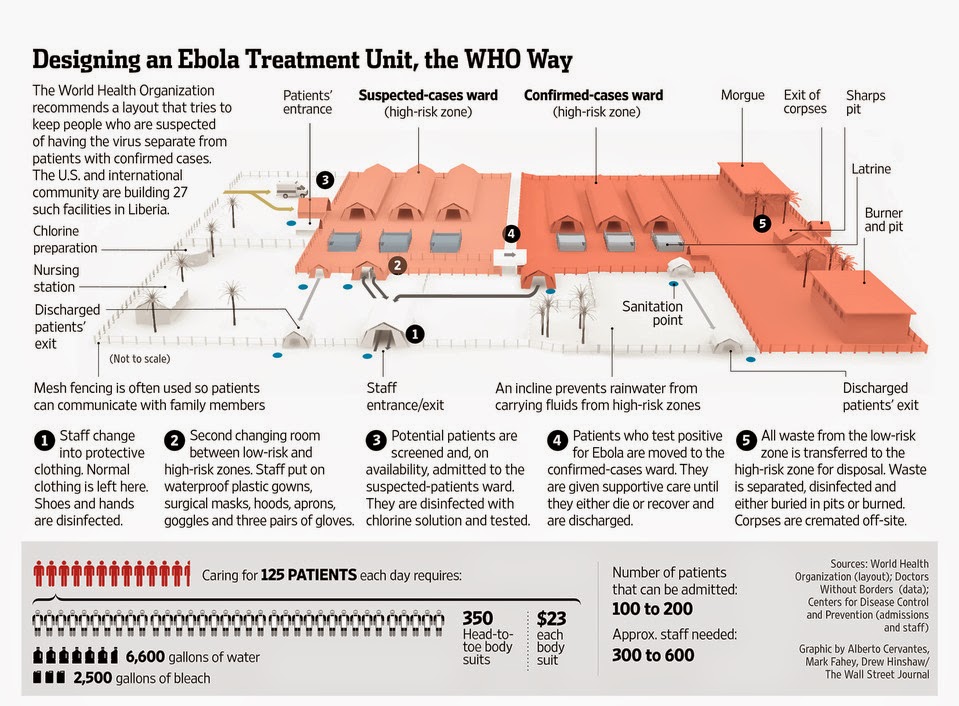
So what happens when somebody gets Ebola? I’ll save the clinical talk for a different time but let me walk you through how a patient is cared for. There are of course many schools of thought - doctors are even worse than lawyers when it comes to arguing - but there are established protocols that most agree on. A patient showing symptoms gets to care sites in many different ways. If a person is laying on the floor of their house or hut showing symptoms people know now to contact the authorities. A specially trained and outfitted team and ambulance goes and gets the patient. They know to bring them to an Ebola Treatment Unit – an ETU. Patients may also show up on foot, via motorcycle or even via wheelbarrow.

Once at the ETU the patient begins to follow a very prescribed path that seeks to isolate and protect the patient and protect the staff. The first part is triage. There, across at least a meter or two of barrier separation, a quick history is taken. The patients are guided on taking their own temperature with an accurate digital thermometer. A judgment call is made right there whether or not the patient fits the criteria. If so, a team in PPE (the spacesuits) comes and escorts the patient into an area where they are cleaned and their belongings gathered. They are now brought to a ward called the suspect ward. Here they have a blood test drawn and samples are sent. The patient receives what is called presumptive care at this point. Presumptive just means you assume that everyone may also have malaria and infectious diarrhea – both very common – and while you are waiting for the test to come back you may as well treat these. Supportive care like nutrition and fluids are also given and of course symptomatic care is given for fevers, pain and nausea for example.

It may take a day or two for a test to come back. If it is positive the person is moved to a completely new ward called the confirmed ward. Additional testing takes place. More aggressive treatment continues. The same categories of care – presumptive, supportive and symptomatic remain. Remember – there is no cure or vaccine for Ebola – yet. There are very strict guidelines on how patients and staff move and travel through the facility. One rule is there is no backtracking. A patient will never go back to the suspect area once confirmed. Remember some there in the suspect area may not have the disease. Likewise, a staff member always travels from suspect to less infectious to most infectious and does not backtrack either in order to minimize the chance of infecting other patients. The whole patient and staff flow is exquisitely choreographed. Those who went before us taught us.

Once in the confirmed ward there are two possible patient outcomes. The patient either survives and recovers or succumbs to the disease. If they recover there is a protocol for confirming a disease free state and the patient is released. They exit through a special area called Freedom’s Gate by some. They are given the appropriate support to include the basics like bedding, clothing and food since most everything was destroyed on arrival. No one is just sent out the door. The communities have a well-established network of support facilities and services. Still, a stigma surrounds Ebola survivors and many find it rough going. It is not unlike that experienced by HIV patients back in the day. Goodness, I just thought about my early days taking care of HIV/AIDS patients back at San Francisco General in the early 80’s. It wasn’t even called AIDS. We called it Gay Lymph Node Disease or Gay Related Immune Deficiency (GRID). We were all so naïve but terrified. Again, the similarities are striking.

Many patients die. Fatality rates range from 20-95% for Ebola. With good care in an ETU setting the more favorable numbers play out. When a patient does die they are treated with the utmost respect but again with very established protocols for the handling of remains. A recently deceased body is highly highly infectious. The ETUs all have proper morgues and a way to handle the remains. A very special NGO called Global Communities has taken the lead throughout this crisis for handling and burying remains. The ETUs transfer the deceased – again protocols – to the Global Communities personnel who transport the patient for burial. Every effort is made to include families in the process with appropriate attention to infection control.

I neglected to mention what happens to those in the suspect ward who prove negative. Those who recover are similarly discharged with the appropriate support. Those who remain ill are usually transferred to a more traditional health care facility or clinic. For caregivers as mentioned there is a similarly stringent workflow that starts with putting on the PPE – donning – through to how to safely perform even the most routine tasks like an IV and then when your shift is complete how to safely remove your PPE – doffing. I’ll save the mechanics of all that for a different time as well.

A couple of good video links give you an even better picture of what goes on inside an ETU. The first link is of the MSF unit at ELWA3 in Monrovia. The second is from another Liberian ETU.


I’ve included some stock pictures of ETUs. You’ll note an abundance of concertina wire and snow fence. No locals call it snow fence but those of us lucky enough to have seen snow or even ski (how I miss it this season) do. The snow fence and concertina wire are to help indeed demand one follows the traffic patterns. No getting in (or out) unless appropriate. No backtracking. No left when you should go right. Some ETUs are refurbished buildings or clinics that already existed in the middle of a town. Some are just tents, although really good tents, and plywood buildings in the middle of the jungle. They all operate in a very similar fashion. They have all been critical to the success to date. Even those that have not seen a patient act as fire stations ready to jump on any ember. There’s still both smoke and fire. The house isn’t burning down anymore but there is still work to do. Lots of it. Don’t believe everything you see or read on the news. In fact, burn your TV in the yard. I haven’t seen TV in months. I don’t really miss it. Ah, that’s a lie. I miss the John Oliver show like crazy. How am I ever going to catch up?

Note: The lyrics to Throw it all Away are by Toad the Wet Sprocket


Snow Fence


Island Clinic ETU


Monday, January 26, 2015

Heaven, what the Hell is Heaven?

A view of Monrovia from the air - my home away from home
Beyond the rules of religion
The cloth of conviction
Above all the competition
Where fact and fiction meet

There's no color lines castes or classes
There's no fooling the masses
Whatever faith you practice
Whatever you believe

Oh, Heaven, Heaven
What the Hell is Heaven?

Throw away your misconceptions
There's no walls around Heaven
There's no codes you gotta know to get in
No minutemen no border patrol

You must lose your earthly possessions
Leave behind your weapons
You can't buy your salvation
And there is no pot of gold…


There are no guns on the street in Monrovia. This is simply mind blowing given the fact this country was torn apart by multiple civil wars over the last two decades. Instead, the weapons of choice are words. Angry words, loving words and words of salvation and redemption. The capital city Monrovia – named after President Monroe - has more churches than any place on the planet. Period. Everything is somehow inspired by, labeled with or branded through Biblical verse. More specifically Biblical verse straight out of the King James Version. Blessed anointed hairdresser. Shadrack Meshak and Abendigo grocers . Blessed Overcomer Auto Parts. Lo and verily office supplies. The list is endless. My favorite branding thoughts though are those found on the back of the ubiquitous yellow taxis. These Datsun like fossils are held together with duct tape, bailing wire and sometimes hundreds of those plastic zip ties police use for handcuffs. They carry up to 8 or 9 people crammed in for short or long distances. One hails these vehicles from the roadside with a wave at waist level that is a combination of a shaka, a quiet down hand signal and a throwing the dice motion. There are of course a million variations but elements of all of the above are in every one. The backs of these vehicles are painted with mostly Bible verses. Corinthians and Proverbs are especially popular. Some are more nebulous like "do not me" and “Boy Armah”.  Others are straight to the point "Shut Up!”  The most clever one by far though said "talk about me". I couldn't get it until I asked our driver and he smiled and just said, "see". There we were, we were talking about him. As we pulled up next to him as the traffic slowed I swear he looked over at us and smiled and knew his sign had worked. Even the trucks have their version of the Liberian bumper sticker. See the picture below. I think it says God is #1, Real Madrid Two is #2 and goes through to Ronaldo who is #7.
Looking for what?


Amidst all the traffic noise one can always pick out the sound of very inspired preaching any day of the week and anytime of day.  I grew up going to church twice on Sunday and even some Wednesday nights. Many Liberians go everyday and all day Sunday. When we first got here my colleague Brian a silver haired and distinguished Kiwi thought it might be proper to go and visit one of the African Methodist churches and show respect and learn some more about the community. They sat him up front in the middle and six or seven hours later he returned exhausted, well fed and hoarse from singing. What I wouldn't give to have a tape of Brian's New Zealand accent joining with the local choir at full volume. Church is serious business here. Every faith is represented although the majority are some type of Evangelical Protestant. Just along the 3-mile strip from the main base to the heliport that I drive nearly every day I counted some 63 churches. Wild. 

Speaking of wild, the pastor of one of these churches is rather infamous in the recent history of Liberia. During the Liberian civil wars he was known to all as General Butt Naked. I am not making this up. And yes, for those of you familiar with the play Book of Mormon this is the man who was the inspiration for the character General Butt Naked. Well, those of you familiar with the play will recall that’s not exactly the character’s name but given the fact my kids read this we’ll leave it at that. He is now an Evangelical minister known as Joshua Blahyi but in his former life was a feared warlord and admitted cannibal and war crime perpetrator extraodinaire. Raised as a Sarpo tribal priest he converted to Christianity when, he says, Jesus appeared to him during a human sacrifice and asked him to repent his sins. Today Joshua Blahyi devotes himself to running a ministry, making amends, and rehabilitating former child soldiers. In his former life he ran the Butt Naked Brigade, a militia aligned with Samuel Doe who ruled the country for a time during the wars. There were countless militias in those days, led by men who adopted noms de guerre such as General Bin Laden, General Mosquito, Colonel Fire in the House, Major Blood and Lt. Double Trouble. Butt Naked’s soldiers were particularly ruthless—killers and rapists who fought naked except for guns and shoes. Their nakedness was meant to instill fear and, they also thought, to protect them. By their own admission, before battle they often sacrificed young children, ate their hearts, and drank their blood. “The hearts were roasted,” Blahyi told a reporter, as if that were a mitigating detail. You can find pictures of the same on the web but they are just far too graphic and disturbing to post. In 2008, in front of Liberia’s Truth and Reconciliation Commission, he claimed that he and his followers had killed more than 20,000 people.

Of all the African conflicts in late 20th century, the Liberian civil wars stand as among the most macabre, gruesome, and sensational. After his capture President Doe was videotaped being tortured. His ears were cut off and he was told to eat them. He finally bled to death on the floor as his captors sat around drinking Budweiser. Child soldiers, some as young as nine, ruled the streets. Taylor called his recruits the “Small Boys Units.” They were fueled by cocaine, alcohol, and marijuana, and would at times fight dressed as women or wearing wedding dresses, wigs, shower caps, and Halloween masks. Some fought naked, cutting off limbs and beheading people as they went. Cannibalism was not unusual. Some 300,000 people died in these wars, about 1 Liberian in 10. As horrific and recent as these memories are the Liberian people have moved on. Grace, forgiveness and redemption are not just words. They are truths they live out everyday. The fact that Pastor Blahyi lives among them is but a single example. There are thousands. Optimism is another overpowering fact of life here. Despite the grinding poverty, the challenges of daily life and the scourge of Ebola they never give up. I thought I was an optimist until I came here. Now I sometimes feel like Eeyore.
Today the former General Butt Naked lives in a rundown suburb of Monrovia called Chocolate City, as in the P-Funk album. George Clinton, like President Monroe, is on the Liberian map. Amazing Grace indeed. Heaven, what the Hell is Heaven.


General "Butt Naked" Blahyi today


Note: The lyrics to Heaven are by Brett Dennen 
and Natalie Merchant. Much of the information on General Butt Naked comes from a Vanity Fair article by Tom Freston


A little slice of my Heaven...